By: Dejan Gradisar and Miha Glavan
From: Jožef Stefan institute, Department of Systems and Control
Reducing household food waste is one of the key challenges in achieving more sustainable food systems. However, measuring food waste reliably at household level remains difficult, as existing methods often rely on self-reporting, questionnaires, or manual diaries that can be time-consuming and prone to inaccuracies.
Within the WASTELESS project, researchers at JSI developed a digital toolbox designed to support more structured and reliable household food waste monitoring. The system combines a Bluetooth-enabled smart scale, a mobile application, and a cloud-based platform into an integrated methodology for collecting food waste data directly at the point of disposal.
The toolbox enables participants to weigh discarded food, classify it into predefined categories, add contextual information such as avoidability and disposal route, and document entries with photographs. The collected data are automatically synchronized to a centralized cloud platform, supporting harmonized reporting and further analysis. The toolbox and associated methodology were tested through pilot activities in four countries: Slovenia, Portugal, Hungary, and Estonia.
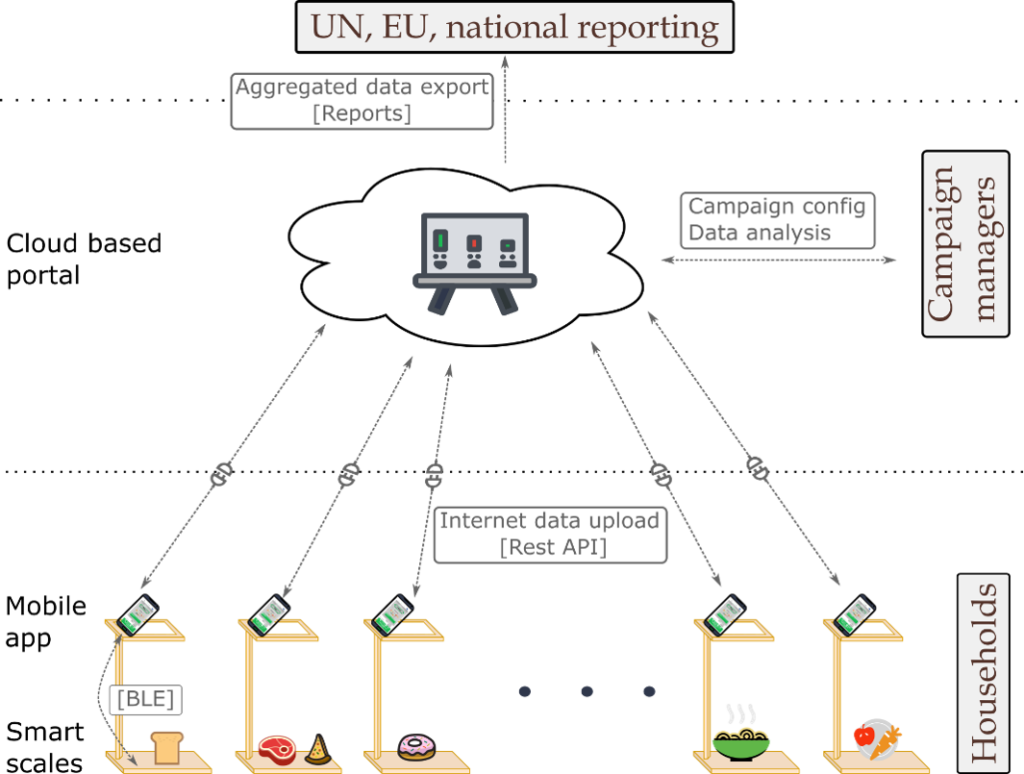
The methodology and first validation results have now been published in the scientific journal Resources, Conservation & Recycling Advances: “Smart scale toolbox for household food waste estimation”: https://doi.org/10.1016/j.rcradv.2026.200317.
The publication presents the design of the digital toolbox, the methodological framework behind the approach, and findings from a pilot validation study conducted in Slovenia. The study demonstrated the practical feasibility of the system in real household conditions and highlighted the potential of digitally supported approaches for improving food waste measurement and behavioural analysis.
Compared to conventional methods, the proposed approach combines direct weight measurement with contextual metadata and photo verification, supporting both quantitative reporting and a better understanding of food waste patterns and behaviours.
The developed toolbox contributes to the broader goals of the WASTELESS project by supporting more reliable, scalable, and policy-relevant food waste monitoring methodologies aligned with EU reporting needs and sustainability objectives.