By: Margarida Bento
From: Federação das Indústrias Portuguesas Agro-Alimentares (FIPA)
7 May 2026
FIPA’s strategy is centred on the overarching goal of showcasing the agri-food industry’s commitment to providing consumers with products that are increasingly nutritious, safe, sustainable and affordable.
With these principles in mind, FIPA’s strategic pillar in the area of sustainability is to mobilize the entire sector towards a sensible approach to the unique relationship that the agri-food industry has with all stakeholders in the value chain, ensuring a balance between resource preservation and long-term competitiveness, from an economic, social and environmental perspective.
What is the industry doing?
Food waste represents a major loss of natural resources and an unnecessary source of greenhouse gas emissions that contribute to climate change.
In Portugal, food waste reached 185 kg per person in 2023.
Households were responsible for 67% of total food waste, corresponding to 123 kg per person.
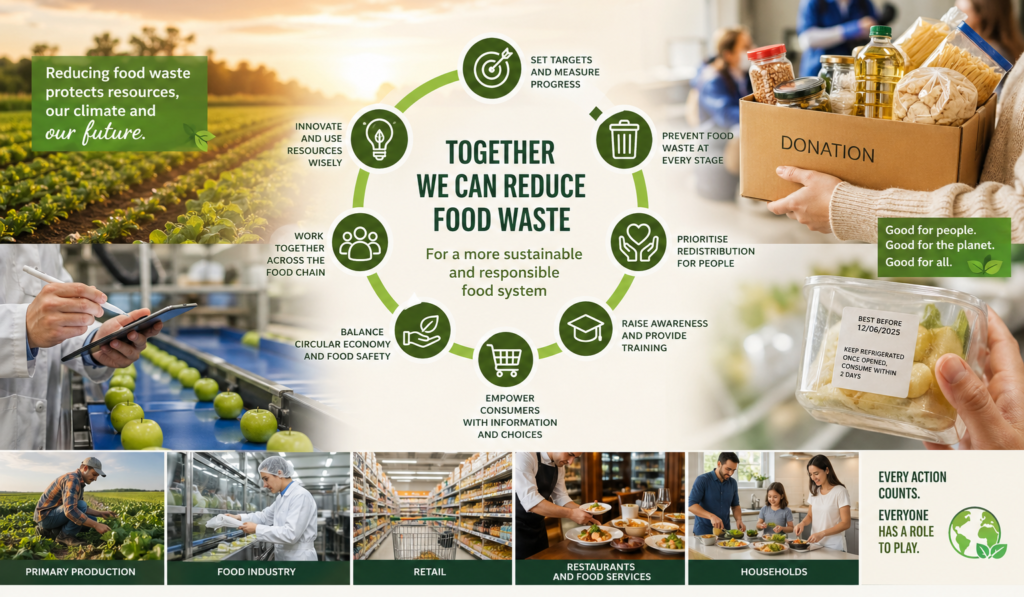
The remaining food waste was distributed across the supply chain as follows:
- Primary production: 13 kg per person (7%)
- Food industry: 5 kg per person (3%)
- Retail: 22 kg per person (12%)
- Restaurants and food services: 21 kg per person (12%)
These figures highlight that, although all actors in the food chain have a role to play, households remain the largest source of food waste in Portugal.
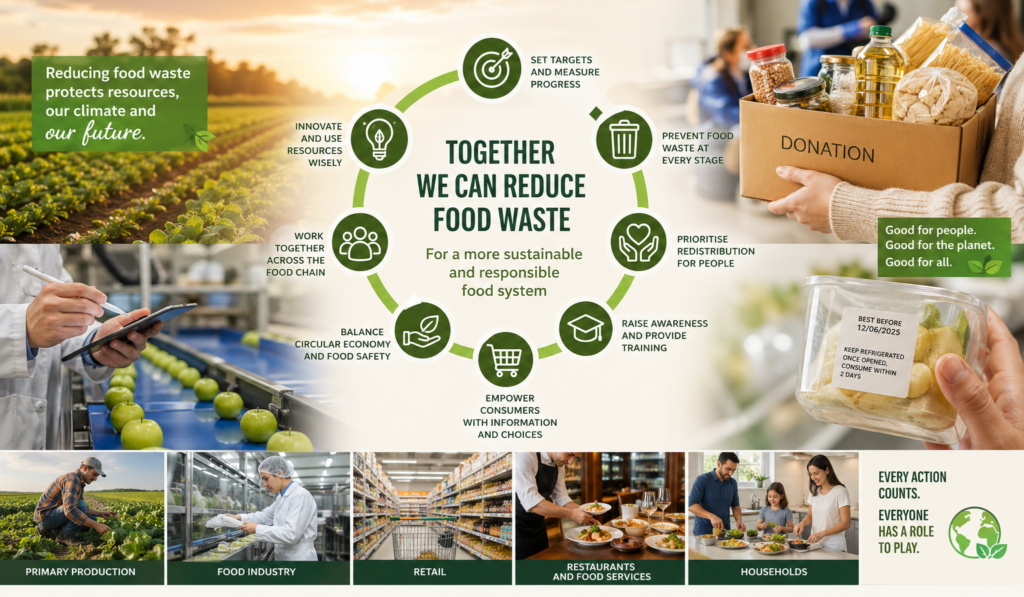
The food industry is committed to taking action to reduce food waste and is already implementing a range of practical measures.
First, we are committed to helping halve food waste by 2030, in line with Sustainable Development Goal 12.3.
Second, we are actively contributing to the EU Farm to Fork Strategy and support the European Commission’s ambition for Europe to become the world’s first climate-neutral region by 2050.
Third, whenever food waste cannot be prevented, we prioritise the redistribution of food for human consumption, in line with the food waste hierarchy.
Fourth, we are improving internal training and raising awareness across organisations on how to prevent food waste at every stage of operations, including production, marketing, procurement and logistics.
Fifth, the industry is setting clear targets to raise awareness, focus attention and mobilise resources to reduce food loss and waste. Action is being concentrated first and foremost on prevention, through a multi-stakeholder approach involving consumers, improved packaging and clearer date marking.
Sixth, we are working to strike the right balance between circular economy objectives and food safety requirements. This means reducing and recycling packaging materials while ensuring that packaging continues to play its essential role in protecting food and preventing waste in a more sustainable and resource-efficient way.
Seventh, we are providing consumers with better information to help them make informed decisions and reduce waste at home. This includes guidance on product characteristics, proper storage, date marking and shelf life, meal planning, freezing options, safe food handling and practical recipes for using food in different ways. We also continue to offer a range of pack sizes to better meet different consumer needs.
Eighth, innovation is essential. It is increasingly important to develop new products that make use of co-products and by-products. This can be achieved through stronger investment in research and innovation, supported by both public and private funding across the supply chain, ultimately benefiting SMEs in particular.
In addition, the development of EU guidelines is essential to support Member States and food business operators in implementing food waste measurement rules. These guidelines help ensure that data is interpreted consistently and that reporting requirements are applied in a harmonised way.
It is equally important to ensure that EU food waste policies remain coherent with other major European Green Deal initiatives, including the Climate Law, the Biodiversity Strategy and the Farm to Fork Strategy.
Some examples
Several companies are already implementing innovative and impactful practices to prevent and reduce food waste.
SOVENA is using olive pomace as a feed component for insect larvae and developing a new organic fertiliser.
This fertiliser, Insect Frass, is produced through the bio-organic digestion of matter by insects and consists of insect residues and decomposed material.
Nutrifarms is currently testing the application of this fertiliser in its own olive groves, with the aim of improving soil quality and nourishing olive trees.
Source: Sustainability Report 2024
Danone is investing in research, innovation and development in both dairy and plant-based products to extend shelf life while maintaining the highest food safety standards.
This transition is also supported by consumer education campaigns carried out in partnership with Too Good To Go.
Source: Integrated Annual Report 2024
Sumol Compal supports food basket donations through a partnership with Atlas – People Like Us.
This initiative supports elderly people experiencing isolation and vulnerability through the distribution of food baskets to all beneficiaries of the “Velhos Amigos” project.
Source: Integrated Single Report 2024
Conclusion
Reducing food waste requires coordinated action across the entire food chain, from primary production to households.
The food industry has an important role to play and is already taking concrete steps through prevention, innovation, redistribution, consumer education and cross-sector collaboration.
However, lasting progress will depend on the combined efforts of industry, policymakers, researchers, civil society and consumers.
By working together, it is possible to build a more efficient, sustainable and resilient food system, while significantly reducing food waste in Portugal.