By: Junos Lukan
From: Jozef Stefan Institute
6 May 2026
WATELESS is all about measuring food loss and waste (FLW). We developed and tested new tools in order to better determine how much food is wasted and ultimately reduce this quantity.
But if you wanted to measure FLW as a food supply chain actor yourself, how would you go about it? At JSI and UTAD, we designed and implemented a toolbox that enables food system actors to select the most appropriate methods for measuring and monitoring FLW according to their specific needs. By guiding users towards context-appropriate quantification approaches and concrete implementation examples, the Decision Support Toolbox directly supports the broader WASTELESS ambition of harmonising measurement practices and strengthening evidence-based decision-making.
How the WASTELESS Decision Support Toolbox works
Stage 1: Find your best method
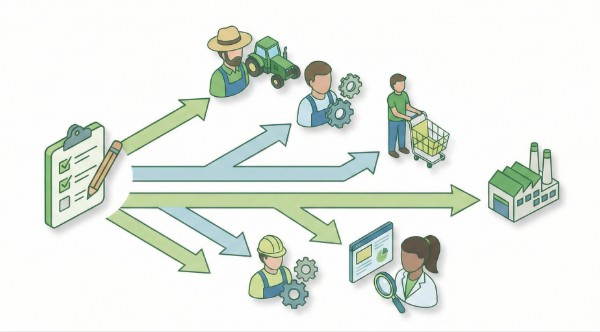
The Decision Support Toolbox (DST) works in two stages to help you choose the best FLW measurement method. In the first stage, it identifies the most suitable general FLW quantification methods for a given use case. This stage builds upon the globally recognised FLW Standard and its Quantification Method Ranking Tool [originally available as an macro-enabled Excel file] which provides a structured questionnaire and scoring logic to assess the appropriateness of different measurement methods. You will answer questions about your needs, such as how your food waste looks like and what you do with it, and the tool scores ten FLW measurement methods between 0 % and 100 % showing you how suitable they are for your scenario.
Stage 2: Connect to real-world examples
The tool goes beyond theoretical methods of measurement. In the second stage, the DST connects recommended methods with real-world examples, documented FLW measurement practices. These practices, collected within WASTELESS and other relevant initiatives, are descriptions of how someone else adapted a general FLW measurement method to their specific needs. To capture this context, they are described using harmonised attributes: region, food supply chain stage, food category, and achieved accuracy. The structure was extracted using large language models (in a process presented in [Slovenian Conference on Artificial Intelligence 2025] to ensure they are easy to compare.
So, in the second stage you can tell the tool where you are from, what is your role in the food supply chain, and what foods are you interested in. The practices are then ranked according both to the method suitability and your context. The DST shows short descriptions of practices (practice abstracts), along with their extracted characteristics and the reasoning for their rank.
How you can use the WASTELESS Decision Support Toolbox
Head over to https://wasteless.utad.pt/toolbox and describe yourself, such as where you come from and what your role in the food supply chain is. You can also fill in a nine-question questionnaire to give a better idea about your FLW, such as whether it is liquid or solid and whether it includes packaging.
When you are ready to see the results, click “Calculate ranking” and you will be presented with the ranking of the FLW measurement methods based on your answers to the questionnaire. This is followed by the list of practices that implemented the methods in situations that most closely resemble the scenario you described.
Remember, there are no correct or wrong answers and there are no universally better or worse methods. The aim is to get recommendations that fit best to your use case. The more answers you provide, the better the system can work.
Ready to find the best method for your needs?
Whether you’re a farmer, distributor, or retailer, the DST is your roadmap to smarter, more effective FLW measurement.
*Explore the Decision Support Toolbox at [https://wasteless.utad.pt/toolbox](https://wasteless.utad.pt/).*
*You are welcome to test it out and send any feedback to [junos.lukan@ijs.si](mailto:junos.lukan@ijs.si) and pcouto@utad.pt.*