From: Chamber of Commerce and Industry of Slovenia
Educational institutions play a unique position in food waste prevention: they are major providers of daily meals and influential environments for shaping lifelong consumption habits. In Slovenia, this challenge is systematically addressed through the Eco-School (Ekošola) programme, an internationally recognised framework for environmental education coordinated under the Foundation for Environmental Education (FEE). The programme promotes sustainable development among children, pupils and students through structured learning, active participation and community engagement. More than 742 kindergartens, primary and secondary schools, student dormitories and faculties are currently involved, engaging over 135,000 children and young people each year.
The Eco-School programme operates through a structured Seven Steps methodology, which guides schools and educational institutions through a structured process to promote environmental awareness and sustainable practice: (1) establish an Eco-Committee, (2) conduct an environmental review, (3) set measurable goals through an action plan, (4) monitor progress regularly, (5) integrate environment education into the curriculum, (6) community involvement (informing, awareness raising and engaging) and (7) adoption of an Eco-Code reflecting the institution environmental commitments. Successfully completing all seven steps the institution earns the internationally recognised Green Flag award, symbolising its dedication to sustainability.
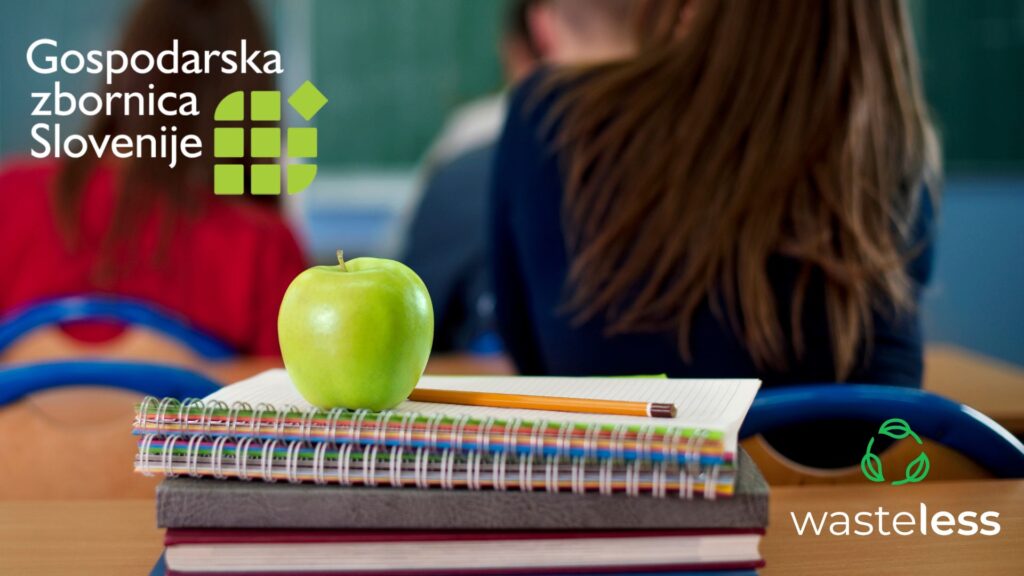
Beyond the core methodology, Eco-School offers thematic projects addressing key sustainability topics such as climate change, circular economy, biodiversity, resource efficiency and waste prevention. In the field of food waste reduction, the key initiative is Food Is Too Good to Waste (“Hrana ni za tjavendan”). This initiative supports public institutions in measuring food waste, identifying its causes and implementing targeted reduction measures. Students actively participate in monitoring plate waste, improving menu planning, optimising food storage and preparation, and designing awareness campaigns.
The Food Is Too Good to Waste initiative also includes two national award competitions. The “Recycled Food Recipes” competition encourages children to create dishes using meal leftovers or food close to its expiry date, with the most creative recipes published annually in a special recipe booklet. The “Food Mindfulness” competition focuses on systematically measuring food waste, analysing its underlying causes, and implementing concrete, evidence-based reduction measures within educational institutions.
Rather than relying solely on awareness-raising, the Slovenian model integrates sustainability into daily operations and decision-making processes. By combining measurable waste reduction with active student engagement and institutional responsibility, the Eco-School programme provides a structured and transferable example of how the education sector can contribute meaningfully to national and European sustainability goals.