From: Federalimentare
The European food and beverage sector, Italy at its forefront, faces a critical challenge: producing more food for a growing global population while reducing environmental impact. This is where circular economy principles become essential, transforming waste into resources and ensuring sustainable growth.
The Italian food and beverage industry is a global benchmark for sustainable production and consumption models, aligned with the EU Circular Economy Action Plan and the Green Deal. The sector’s approach integrates environmental, economic, and social dimensions, aiming to:
- Optimize resource use: Italian companies have cut water consumption by up to 60–70% per ton of product and reduced energy use by 30% in 20 years, lowering CO₂ emissions by a similar margin.
- Valorize agricultural raw materials and by-products: Every component of the raw material is utilized, whether for food, feed, cosmetics, pharmaceuticals, or bioenergy, creating a virtuous cycle that minimizes waste.
- Prevent food waste: Through advanced packaging, portioning, and consumer education, the industry addresses the fact that 45% of food waste in Italy occurs at the household level (EU average: 54%).
Packaging: A Strategic Asset
Packaging is often misunderstood as an environmental burden, yet it plays a vital role in food safety and waste reduction. Federalimentare stresses that the problem is not plastic itself but its mismanagement. Plastics ensure hygiene, extend shelf-life, and reduce spoilage—key factors in sustainability.
Italy is committed to:
- Eco-design and material reduction: In Italy, in the last decade, plastic use in some packaging types has dropped by 30–40%, aluminum by 30%, and glass by up to 60%.
- Recycling leadership: Thanks to the CONAI system, Italy has already surpassed EU recycling targets for most materials, with 76.7% of packaging recycled – surpassing the EU 2030 target of 70%.[1]
- Avoiding fragmented bans: Federalimentare warns against local “plastic-free” ordinances that create legal uncertainty and harm competitiveness without real environmental benefits.
Circular Economy in Action
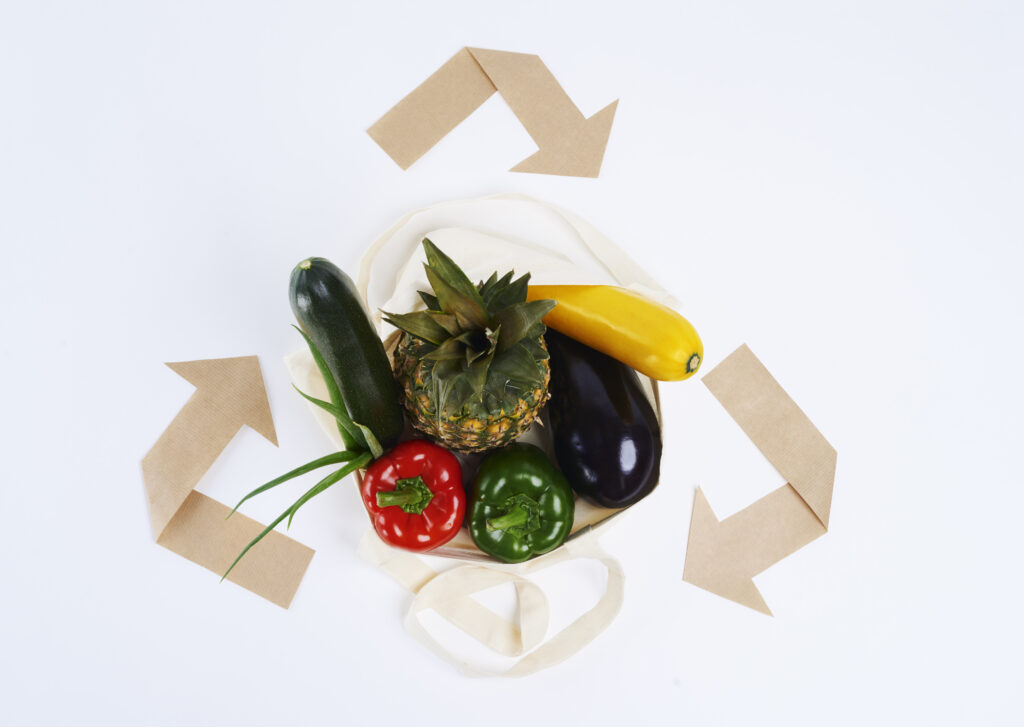
The Italian food industry generates millions of tons of by-products annually, but these are increasingly seen as resources, not waste. From animal feed to bio-based chemicals, companies are creating closed-loop systems that reduce environmental impact and open new markets. Examples include:
- Animal feed from cereal by-products.
- Bio-based chemicals from fruit peels.
- Energy from organic residues.
Shared Responsibility and Education
Circular economy success depends on collaboration:
- Industry and institutions: Harmonized EU rules prevent market fragmentation and ensure fair competition.
- Consumers: Awareness campaigns promote proper waste disposal and recycling.
- Research and innovation: EU programs like Horizon Europe support technological solutions for sustainable packaging and resource recovery.
Federalimentare Commitment to Research and Innovation
Circular development is powered by innovation, and Federalimentare plays a central role in connecting Italian companies with European research networks. Through its coordination of SPES GEIE (Spread European Safety) and the National Agrifood Cluster CL.A.N, Federalimentare ensures Italian SMEs access EU funding and cutting-edge projects.
EU Projects Involving Federalimentare now or in the past, in addition to WASTELESS:
- LIFE-Food.Waste.StandUp – Awareness and training to reduce food waste and redistribute surplus food.
- REINWASTE – Promoting innovative solutions to reduce inorganic waste in the agri-food sector.
- PEFMED & PEFMED PLUS – Applying the EU Product Environmental Footprint methodology to Mediterranean food chains.
- DAINME-SME – Supporting digitalization and innovation for SMEs in the food sector.
- SecureFood – Enhancing food safety and traceability through advanced technologies.
These projects demonstrate Federalimentare proactive role in driving innovation, technology transfer, and sustainability, ensuring that Italian food and beverage companies remain competitive while meeting EU Green Deal objectives.
***
To conclude, Italy is a pioneer in circular economy practices across the entire food and beverage sector. This leadership is built on a systemic approach that integrates resource efficiency, waste prevention, and innovation throughout the supply chain. Italian food and beverage industry exemplifies how circular economy principles can drive growth, reduce environmental impact, and secure food security for future generations. By combining efficiency, innovation, and collaboration, the sector is not only meeting EU sustainability goals but also setting the standard for others to follow.